
The People Value Chain
HPP6: How to build People Strategy and Initiative Roadmaps that change how the business actually works.

The People Value Chain is a simple method for connecting a company’s business goals to the work that delivers them, and then to the People and Org Design changes that enable that work. The aim is to create a Leadership Team–aligned roadmap of People Initiatives that is precisely scoped to measurable business impact.
Most organizations get stuck in activity overload. They run engagement surveys, performance reviews, reorgs, and training initiatives, yet the business does not meaningfully improve. In top scale-ups, the issue is not effort. It’s that much of this work isn’t connected to how the company actually creates value.
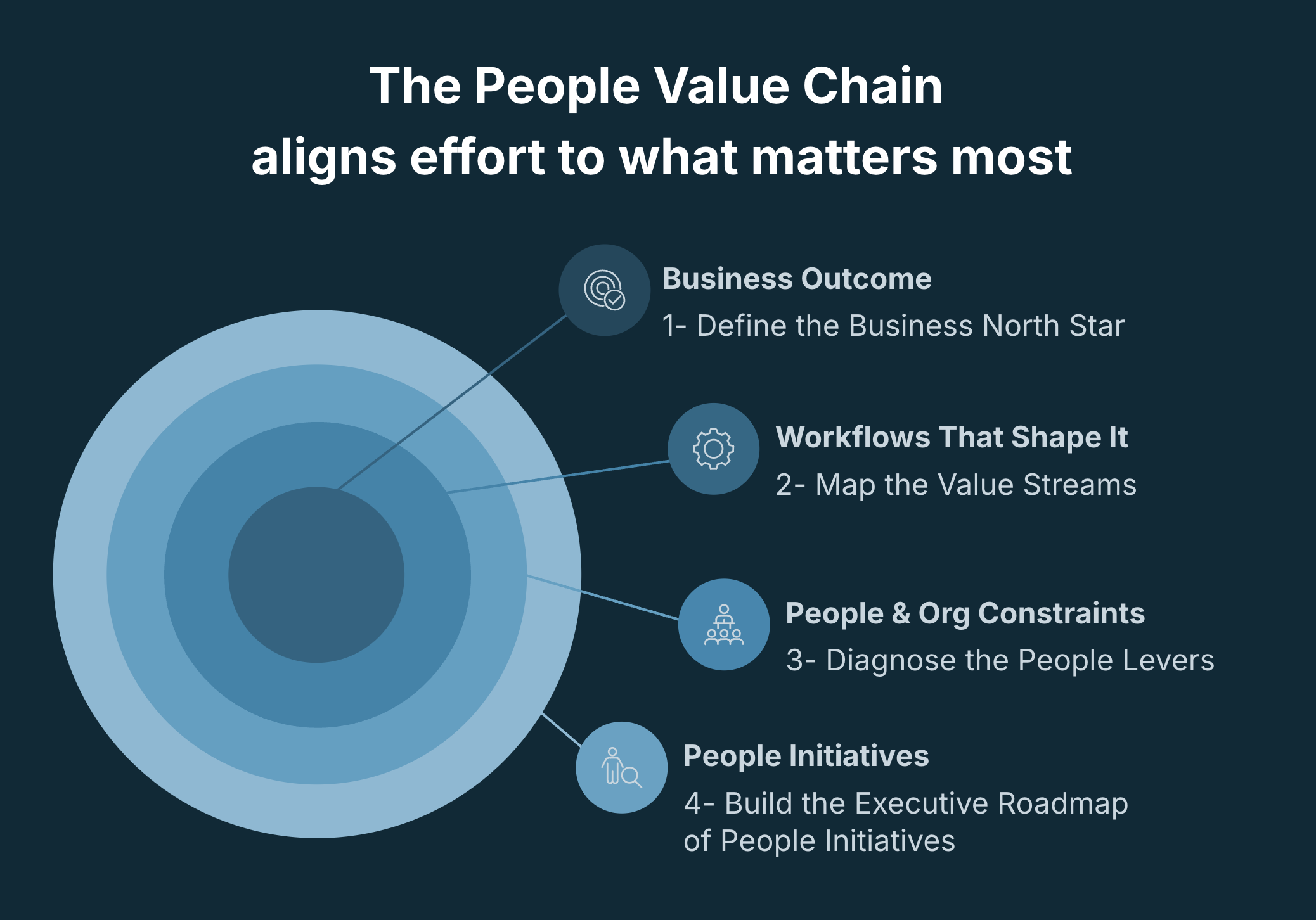
This keeps leaders from chasing scattered HR programs and helps them invest in a small number of targeted, testable changes tied directly to performance.
How the Process Works in Four Steps
1. Define the Business North Star
Core Question: What is the single business outcome that matters most in the next 12–24 months?
A North Star is the measure of the value the business must deliver. It guides prioritization and trade-off decisions for the leadership team. It’s too high-level and lagging to tie directly to People Initiatives, but it sets the essential scope for the rest of the chain.
Common examples:
Net new ARR
Customer retention
Product Usage
Output:
A short North Star statement with one or two clear metrics.
2. Map the Value Streams
Core Question: What are the few core flows of work that contribute most directly to the North Star?
Value Streams are the cross-functional flows of work that show how the business actually creates value and what that work produces. They make clear the outputs that must be delivered, at the right quality, frequency, and scale, to achieve the North Star.
People and org changes only create impact when they improve these flows. If you don’t understand the work, you can’t design changes that improve it.
Common examples:
1- Product Development:
This stream evaluates how effectively the company turns opportunities into shipped, adopted product that delivers value.
Process Stages:
Discover & Prioritize: Product identifies customer problems, sizes opportunities, and ranks work by impact and confidence.
Design & Specification: PM and Design create flows, prototypes, requirements, and acceptance criteria.
Build & Test: Engineering develops, integrates, and tests the feature; QA ensures quality and stability.
Release & Monitor: DevOps and Release Engineering deploy; Product monitors quality, adoption, and performance.
Launch & Enable: Product Marketing communicates value and equips sales and support.
Workflow Outputs:
Feature meets acceptance criteria and quality bar
Solution validated against stated user need
Clear insights produced for the next iteration
This flow reveals where prioritization breaks, specs lack clarity, engineering is blocked, or release processes create friction.
2- Acquire & Close:
This stream evaluates how predictably and efficiently the company converts market demand into high-quality revenue.
Process Stages:
Demand Generation: Marketing generates inbound and outbound interest.
Qualification: SDR/BDR validates fit, timing, authority, budget, and need.
Solutioning & Proposal: AE shapes requirements, builds the value case, models pricing and margins, and validates feasibility with delivery teams.
Closing & Contracting: AE, Legal, and Finance finalize terms and economics.
Handoff to Delivery / CS: Expectations and success criteria transfer cleanly.
Workflow Outputs:
Data-rich pipeline with accurate forecasting
Precise scoping and pricing with clear margin expectations
Clean handoff with aligned expectations and no operational surprises
This flow highlights where pipeline quality drops, deals get mis-scoped, or cross-team handoffs create churn.
Output:
A simple map of 2–3 value streams with defined outputs and current breakdown points. Multi-product or complex organizations may have more, but focus on the fewest necessary.
Most of this information already exists inside the company. The process surfaces it through structured discovery.
3. Diagnose the People Levers (What’s Blocking the Work)
Core Question: Which People Levers could most improve how the Value Streams produce their outputs?
This step surfaces the people constraints that slow or distort the Value Streams. It shifts the conversation from high-level solutions (“we need manager training” or “we need to clarify ways of working”) to real workflow issues (“handoffs break because ownership is unclear” or “managers cannot coach because their spans are too wide”).
Each constraint sits in one of the four areas below, covering two dimensions (Systemic–Behavioral and Group–Individual), which helps us see where constraints originate.
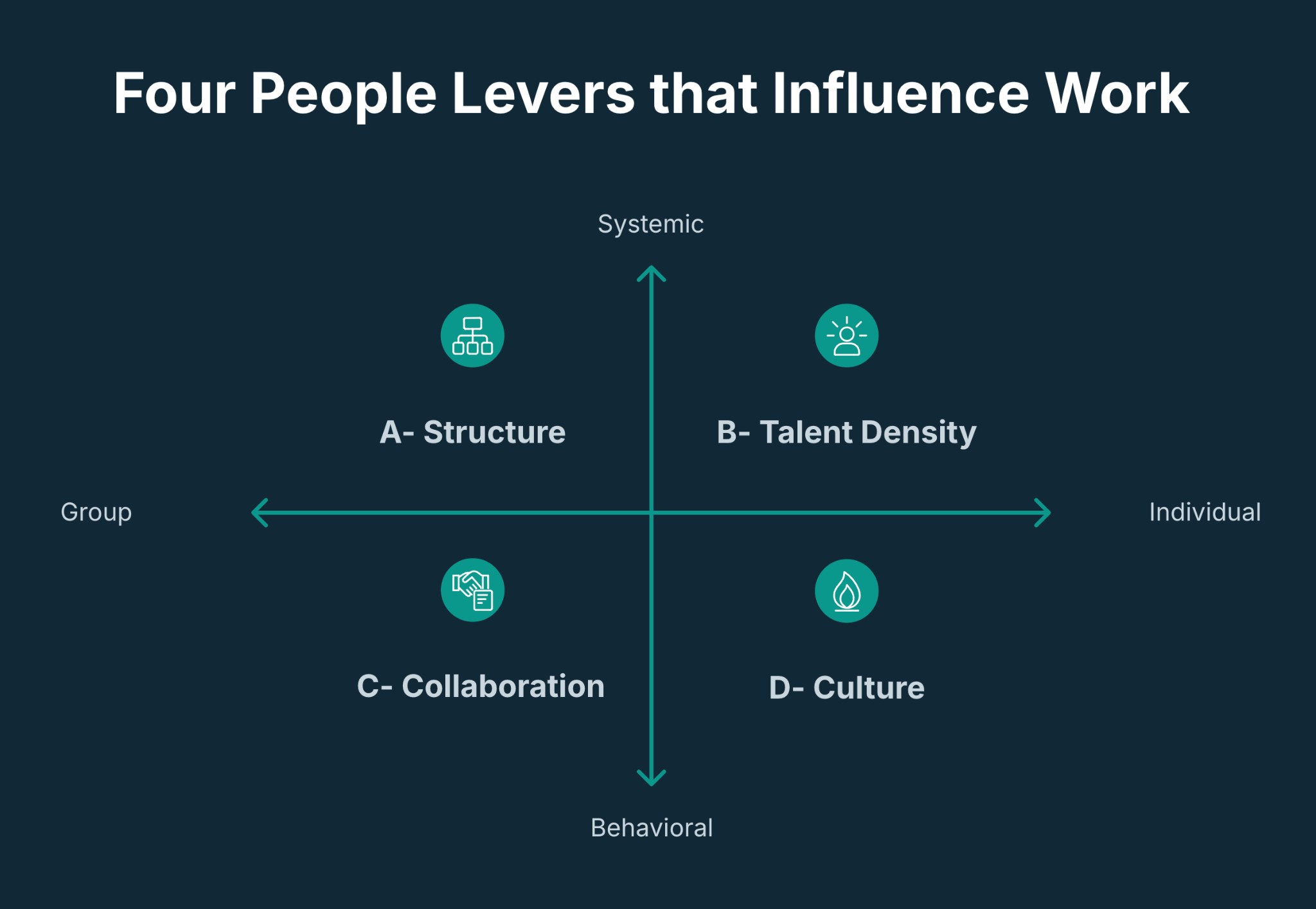
For each Value Stream, we walk through all four areas, map the influencing Levers, and then prioritize the few that would make the biggest difference. This focus becomes our People Strategy.
A. Structure
How the organization is set up to support the work.
Team and pod design
Reporting lines and spans of control
Role clarity, accountabilities, and decision-rights
Cross-functional interfaces
Structural issues often show up as slow decisions, unclear ownership, duplicated work, or leaders stretched too thin to coach.
B. Talent Density
Who is in the seats, and what they can actually do.
Leadership and manager capability
Skill gaps that need to be filled
Hiring needs
Managing out to raise the quality bar
Talent constraints appear as repeated errors, weak judgment calls, or leaders unable to run the pace the work requires.
C. Collaboration
How teams coordinate and make decisions together.
Alignment and review cadences
Handoff practices and issue-surfacing
Communication and knowledge-sharing
Goal clarity and connection to outcomes
Collaboration constraints usually show up as friction between teams, slow escalations, mismatched expectations, or teams working at cross-purposes.
D. Culture
The motivation, ownership, and energy needed to sustain the work.
Connection to purpose
Drive for the work / Burnout
Trust across teams and in leadership
Accountability and outcomes
Cultural constraints often appear as low follow-through, weak standards, inconsistent accountability, or teams doing the minimum needed.
Output:
For each Value Stream:
Create a People Strategy statement for each Value Stream: “We will focus on [A, B, and C specific aspects of the levers], to achieve [desired change in Value Stream output] in [timeframe]”.
4. Build the Executive Roadmap of People Initiatives
Core Question: What high-impact work must the Leadership Team align on to shift the Levers and improve the Value Streams?
Our People Strategy informs the People Roadmap: the set of initiatives needed to move each of the Levers we prioritized. Each initiative is scoped to improve a specific part of a Value Stream. That level of clarity helps us target, assess, and iterate until the workflow actually improves.
The Roadmap should be shared across the Leadership Team, reviewed in executive meetings, and updated monthly. It shows leaders where their involvement is needed, what trade-offs they’re making, and what will or won’t ship. It also creates order in the parallel work that growing companies rely on, making People and Org Design efforts feel more coordinated and predictable.
For a deeper look at applying product thinking to People work, here’s more detail from me: hardpeopleproblems.com/p/people-product-managers-playbook
Output:
A People Roadmap for the current quarter and the two that follow, in a format reviewable by the Leadership Team in a 15-minute agenda item.
Each Initiative on the Roadmap is scoped well to:
show how it will improve a Value Stream,
identify its main users or internal customers,
the “lift” level needed from the Leadership Team, and
indicate its current stage (Discovery, Design, Build, Launch).
The Leadership Team is aligned on the Roadmap’s priorities, the impact each item aims to achieve, and the role they play in delivering it.
What You Leave the Process With
1. A Shared View of How People and Org Design Shapes How the Business Really Works
The process gives the company a clear, shared map of how People factors shape the work across Product Development, Go-to-Market, and Operations.
For the People team, it builds a deeper grasp of the business mechanics so solutions are grounded in real work, not generic best practices.
For the Leadership team, it reveals how People and Org Design choices directly affect speed, quality, and scale.
2. The clarity to prioritize real business impact — and the ability to keep work anchored to it
The method aligns the company on three layers of impact: the North Star, the outputs of the Value Streams, and the critical workflows within them. This makes it easier to see which changes matter most and where to focus time, talent, and investment.
Because every Initiative is scoped to improve a specific piece of the workflow, the work stays tied to business impact through design, assessment, and iteration. This prevents low-value activity and helps the company build faster by concentrating effort on the changes that actually shift performance.
3. A Leadership-Owned Plan for Driving the Changes That Matter
You finish with an Executive Roadmap that shows what will ship, when, and where leadership involvement is required. People initiatives only succeed when executives shape them early (so they’re relevant and realistic) and support them visibly at launch (so teams adopt them on Day One). This turns People and Org Design from an HR task list into a shared leadership agenda.